Realism in hacking minigames
Spoiler: Most games are not accurate about hacking. This is mostly because real hacking looks like this.
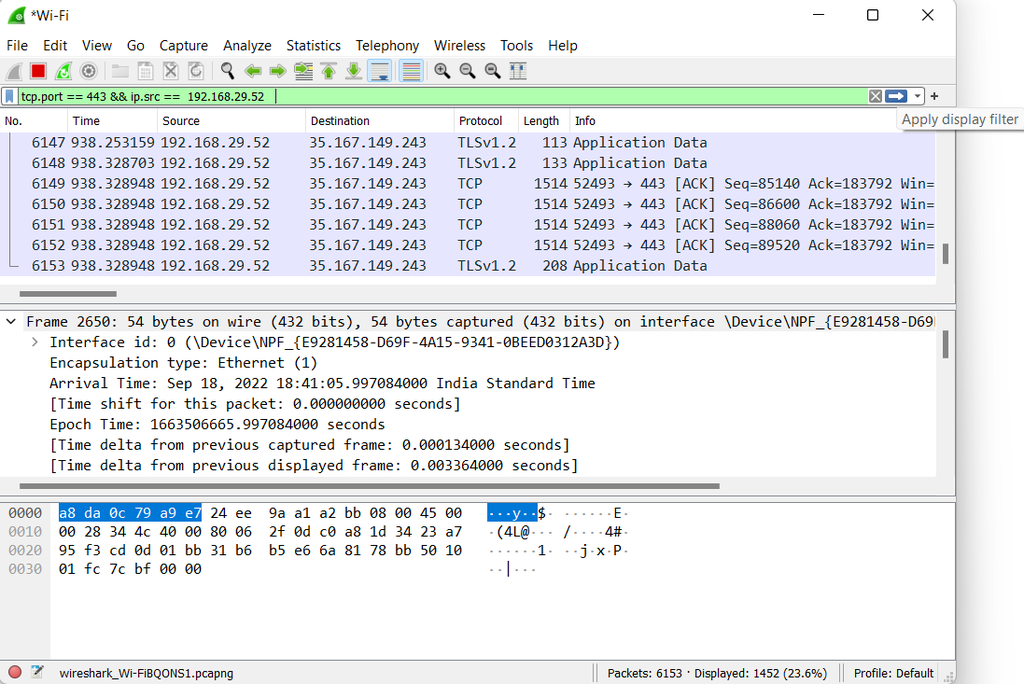
Source: https://www.geeksforgeeks.org/ethical-hacking/steps-of-filtering-while-capturing-in-wireshark/
It's ugly! It doesn't even have dark mode! So most games change things up to make things more interesting. Although, with the popularity of Papers, Please and other detail oriented games, maybe a more realistic hacking game would be fun for people. Maybe not me, since I got really impatient with Papers, Please.
Here are a few of the games I've played, and my unsolicited opinions on the accuracy, fun, and the weird way these games all interact with morality.
As one note, I'm not saying that if a game is completely inaccurate about how cybersecurity works, this makes it a bad game. Hence, the fun score. Contrary to my grumbling when I play any hacking minigame ever, I don't actually mind when cybersecurity is depicted inaccurately. The interesting question to me is what this says about the ideas people have around security.
Dispatch
Dispatch is a superhero game, and with a choose your own adventure element. Is this basically a visual novel /Twilight for straight men? Maybe, but I would die for Coupe now!
To start out with, Dispatch has a hacking segment that's barely fun. Compared to the dispatching and choose-your-own-adventure narrative with the rest of the game, the hacking is somewhat annoying and I'm NOT just saying this because I was really bad at it.
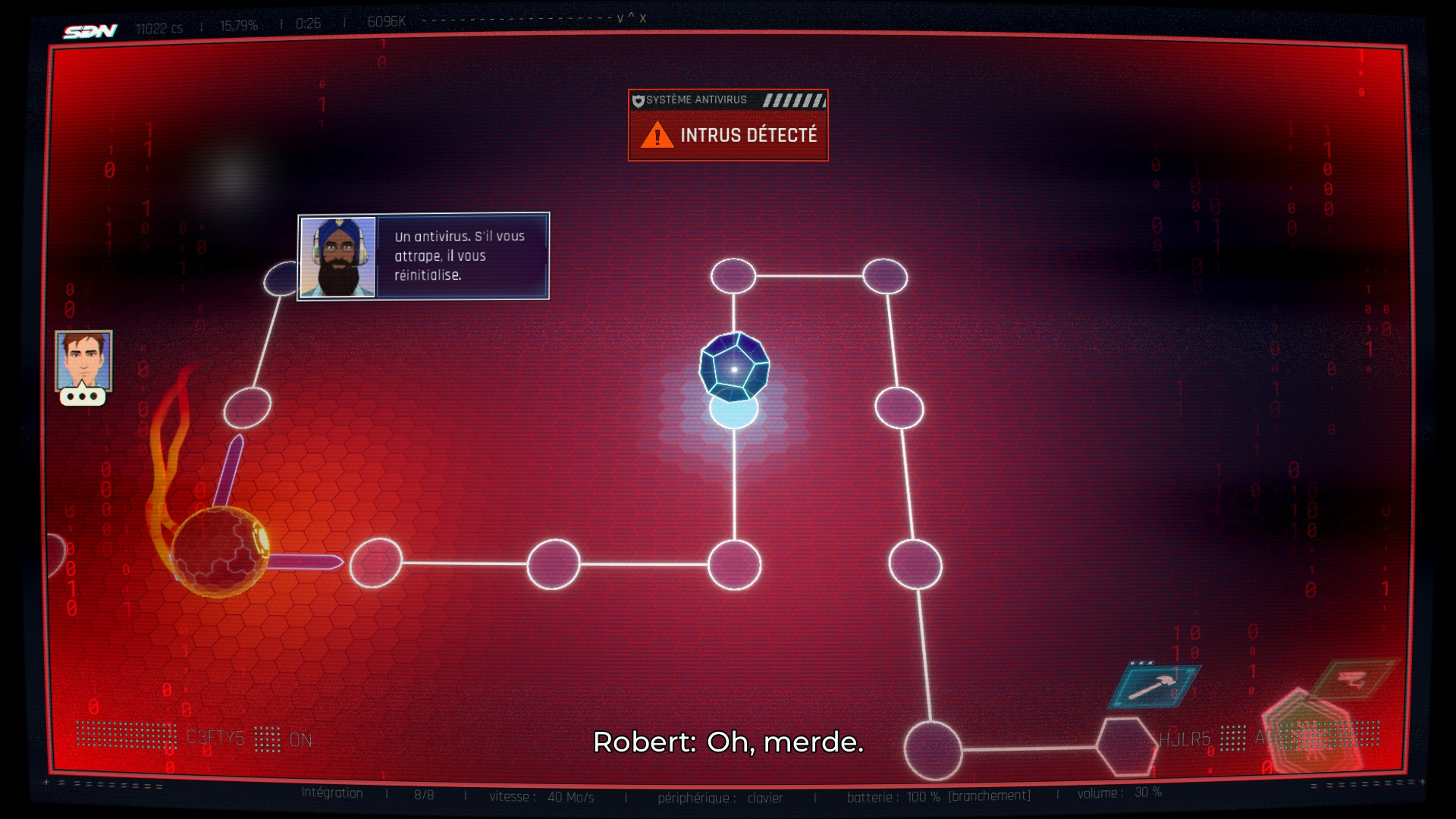
Source: https://www.gameblog.fr/jeu-video/jeux/tests/test-dispatch-pc-706288
Hacking in Dispatch involves moving your little sphere around, and avoiding the red spheres who represent a firewall. You reach a checkpoint, and tap the arrows to 'hack' into the system and access cameras or information.
Looking at the UX, it's very techy and cool looking. Soothing dark mode, hexagons, and circles. Why hexagons for tech stuff? The world may never know...
Dispatch isn't pretending to be a hacking game. Most games aren't, which is fine. The superhero media is also incredibly terribly inaccurate about medical information, to add excitement to the story. Hacking would be boring if it was exactly how it is in the real world.
But then this raises questions about what ideas people are building about hacking from these games. TV shows are also sensationalized when it comes to hacking. This would be fine if people rarely experienced hacking, but we're now in a world where phishing emails are everywhere, scams and hacks are everywhere, and it doesn't look like how the game plays out. Ok, the Facebook profile I reported is still posting AI scams. But they're cookies now.
What if Dispatch used a different mechanic to 'hack', where Robert Robertson just sent phishing emails to people? This feels slightly cruel to do. Much more cruel than moving a little sphere through a maze. What does this imply about the game mechanic now? Does it glorify hacking? Do we want to glorify hacking? Were the developers of Dispatch thinking about this or were they just developing based on the stereotype of hacking?
Additionally, if you're bad at hacking, you end up getting a bad ending in Dispatch. As in (slight spoilers); a certain character turns to the evil side if you're catastrophically bad at hacking. This isn't quite assigning morality to you as the player, or the player character, but rather someone else.
Final scores!
| Thing | Score |
|---|---|
| Accurary | 1/10 |
| Fun | 3/10 |
| Morality | Doing bad at the hacking game affects the morality of a different character. |
Cyberpunk 2077
Hey, it's that game with Keanu Reeves.
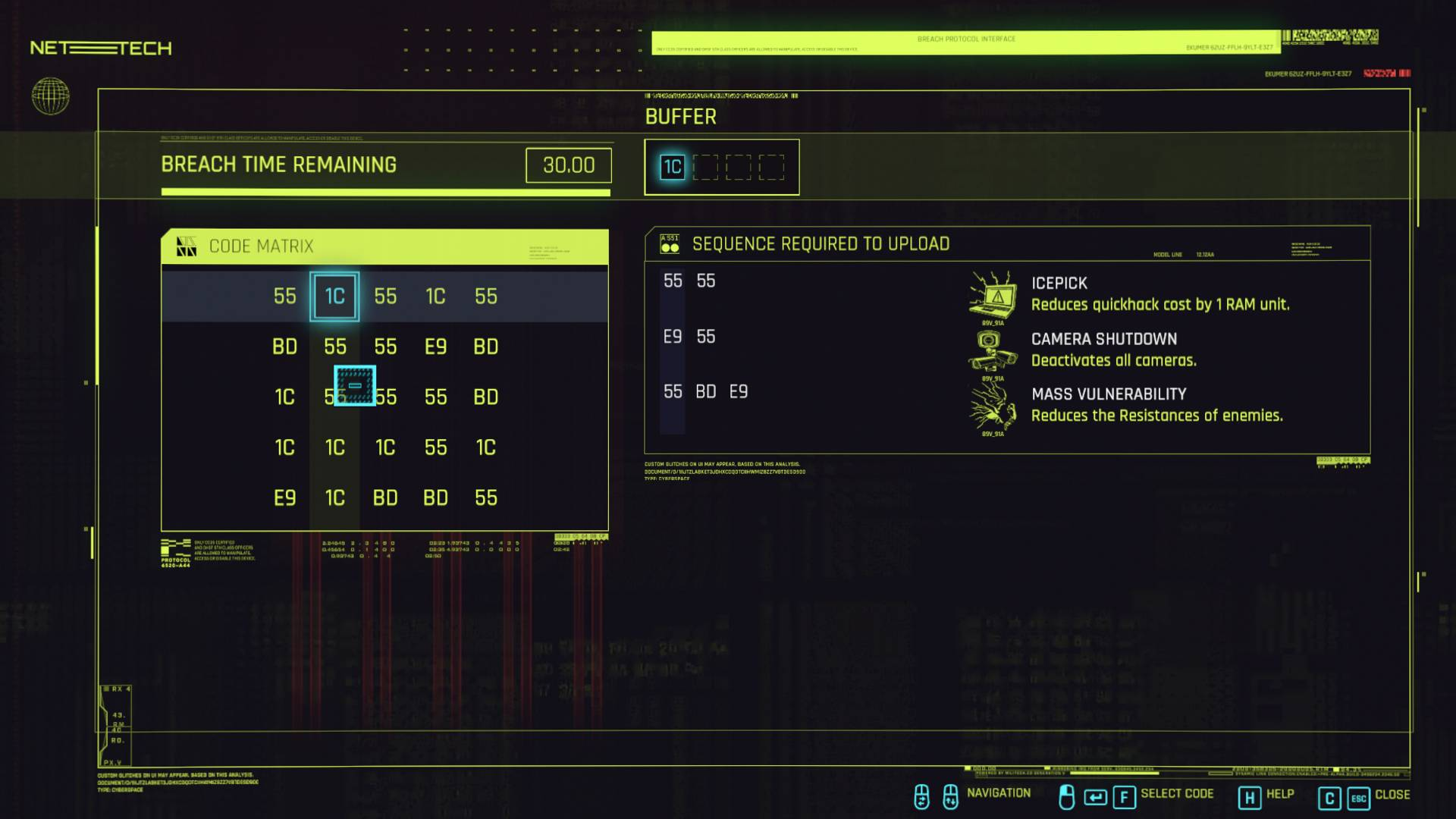
Source: https://www.pcgamesn.com/cyberpunk-2077/hacking
HEY, that matrix looks familiar!!
Cyberpunk 2077 has the hacking mechanic much more integrated into the game. You can be a Netrunner, where you run around exploding people's brains. To do so, you need to solve this little puzzle with a code matrix.
The code matrix has hexadecimal codes. These are one of the ways a file can be formatted, and how the computer can read hexadecimal.

Now, this is using more of the aesthetics of hacking. The interactive element includes matching numbers around and selecting the right hexadecimal code, but also is upgraded with video game elements. You can't hack if you're not at the right level yet, and you can level up and upgrade your own implants in Cyberpunk to improve your skills.
Morality is more complex in Cyberpunk. Unlike Dispatch, which has a 'good' and 'anti-hero' ending based on the choices you make, there isn't a morality system. You have several endings based on choices you make, but they're all related to...like...Keanu Reeves taking over your brain, not a good or bad ending. Smarter people than me have talked about the morals or lack thereof in Night City. I liked Hello Future Me's video: https://www.youtube.com/watch?v=hyfU4o-upH8&pp=ygUeY3liZXJwdW5rIDIwNzcgaGVsbG8gZnV0dXJlIG1l
But anyway, I'm going to humbly place forward a simple morality idea for Cyberpunk 2077. You can choose to stealth, non-lethally take down enemies, and help your friends. Completing these tasks feels nicer than playing a meaner character. Morality solved!
Ok, tying this back to hacking. It's WAY easier to complete stealth missions in Cyberpunk 2077 if you focus on Netrunning (hacking). This means it's easier to murder less people, well, aside from the exploding them part. But that's not required to complete some missions! Arguably, this might mean that being a hacker, in the Cyberpunk universe, is more ethical than a merc or a corp worker.
| Thing | Score |
|---|---|
| Accurary | 7/10 |
| Fun | 6/10 |
| Morality | Not affected; but could be argued that hacking makes a 'kinder' route easier |
Star Wars: Knights of the Old Republic
Why are you reading this when you could be playing KOTOR?
If you haven't played KOTOR, then you're in for a treat. Every game I've played after KOTOR I think in the back of my mind: "I wish this was more like KOTOR." ESPECIALLY with Dispatch.
Star Wars famously doesn't have encryption. All it takes to access a system is physically getting to a terminal. (Source: the movies.) KOTOR makes this more of a game by requiring 'slices'. You can upgrade computer skills and use slices to get into the computer. You can gain slices from gathering materials from around the spaceship.
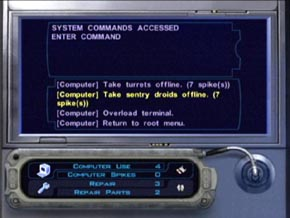
Source: http://xbox.gamespy.com/xbox/star-wars-knights-of-the-old-republic/guide/page_6.html
Now, I'm scratching my brain to figure out how this works as a hack. Do the slices represent USB sticks? RAM? Just like. A bunch of tiny laptops. I have no idea. Setting aside any logistical thoughts on this, I like this mini game a lot and therefore it gets a good fun score.
Now the morality element! KOTOR doesn't really assign morality points to the hacking, but instead the dialogue choices your character makes. Except for one notable exception, when you are trying to negotiate with a computer on Kashyyyk. For a very big spoiler reason that is really better revealed in the game, you can easily convince the computer to give you this thing called a Star Map (which you need to complete a quest) if you say 'evil' options.
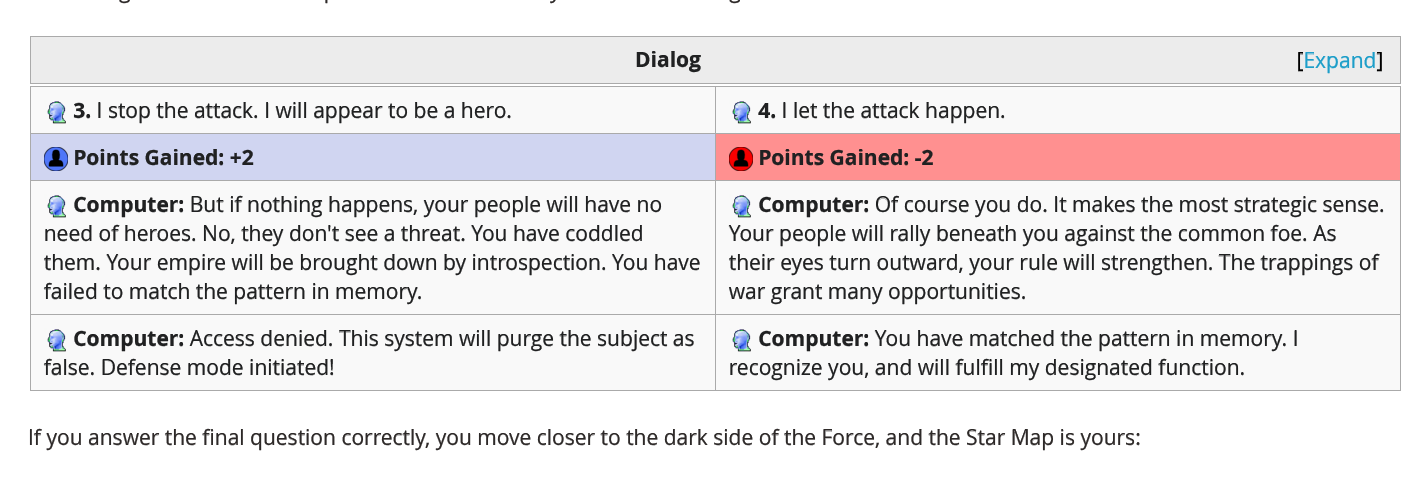
Source: https://strategywiki.org/wiki/Star_Wars:_Knights_of_the_Old_Republic/Lower_Shadowlands
When I first played this, I saw the computer wanted me to say the 'evil' dialogue options. I just shrugged it off and gave the computer those dialogue choices, pretending to be someone different than my playthrough (since I was playing as a Light side Jedi). However, I still got dark side points. This isn't really a game mechanic that assumes you're going to lie to the computer. Interestingly, you can reach the ending of the game and win either taking the 'evil' or 'good' pathways. So, in this case, hacking a computer can affect long-term morality in this one instance.
| Thing | Score |
|---|---|
| Accurary | 4/10 |
| Fun | 10/10 |
| Morality | Affected slightly at one point in the game |
Summary
I noticed a theme with the way hacking is portrayed here. It's portrayed usually as a skill, with a few aspects relating to morality. It's not usually realistic, but also that doesn't impact what makes it fun. There's a ton more video games with hacking mini games that I didn't go into here, but I think there's a lot of ways that cybersecurity is shown in popular media that's under looked.